
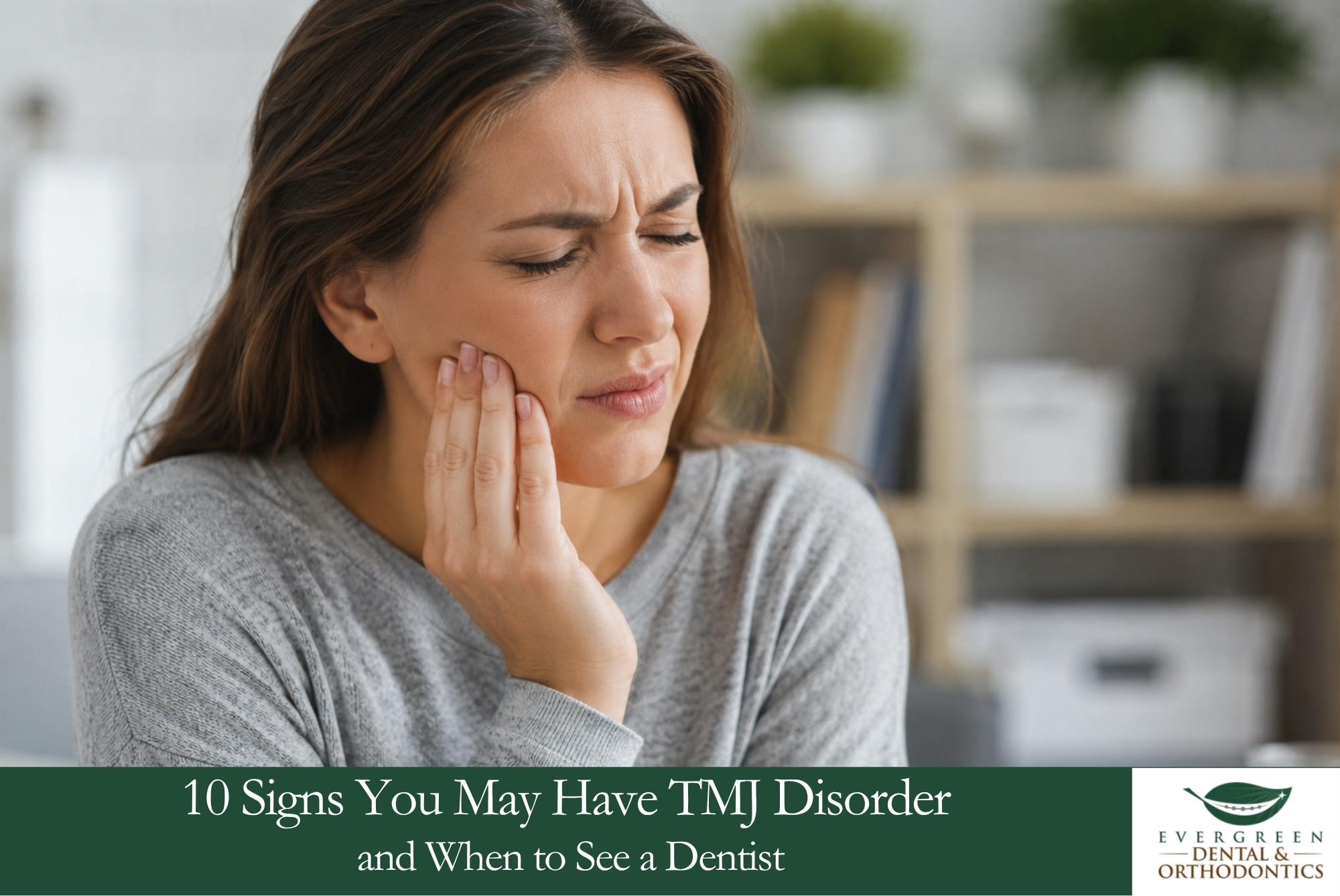
Jaw discomfort can be easy to dismiss, especially when it comes and goes. However, recurring jaw pain, clicking, headaches, facial soreness, or difficulty opening your mouth may point to a temporomandibular joint disorder, commonly called a TMJ disorder or TMD.
The temporomandibular joints are located on either side of your head, just in front of your ears. They connect the lower jaw, or mandible, to the skull and work together with surrounding muscles, ligaments, and other structures to help you speak, chew, swallow, and yawn. Because these joints are involved in so many everyday movements, problems affecting them can have a noticeable impact on comfort and function.
TMJ symptoms can have multiple possible causes, and jaw pain does not automatically mean that you have a temporomandibular disorder. A professional evaluation is important when symptoms are persistent, worsening, interfering with normal activities, or accompanied by limited jaw movement.
At Evergreen Dental & Orthodontics in Encino, CA, patients experiencing jaw-related symptoms can receive a dental evaluation to help determine whether their symptoms may be associated with the jaw joints, teeth, bite, or other oral health concerns.
What Is TMJ Disorder?
The term “TMJ” technically refers to the temporomandibular joint itself. “TMD,” or temporomandibular disorder, refers to a group of conditions involving the jaw joints, chewing muscles, and associated structures. In everyday conversation, however, many people use “TMJ disorder” to describe these conditions.
Temporomandibular disorders can present differently from one person to another. Some patients primarily notice pain, while others experience joint noises, restricted movement, headaches, muscle tenderness, or several symptoms at the same time.
Because symptoms can overlap with dental problems, headaches, ear-related conditions, and other disorders, proper assessment is preferable to trying to diagnose the problem based on symptoms alone.
1. Persistent Jaw Pain or Tenderness
One of the more recognizable signs of a possible TMJ disorder is recurring pain or tenderness around the jaw. Discomfort may occur directly over the jaw joint near the ear or affect the muscles along the cheeks, temples, or lower face.
The pain may become more noticeable while chewing, talking for extended periods, yawning, or opening the mouth widely. Some people also notice greater jaw soreness after waking, particularly when nighttime clenching or grinding is involved.
Occasional soreness does not necessarily indicate a TMJ disorder. Persistent, recurrent, or progressively worsening jaw pain is a reason to discuss your symptoms with a dental professional.
2. Clicking, Popping, or Grinding Sounds in the Jaw
You may notice clicking, popping, or grinding when opening or closing your mouth. Jaw noises can occur for several reasons and are not always a sign that treatment is necessary.
A painless click without restricted movement may not indicate a significant problem. However, joint sounds deserve more attention when they occur with pain, tenderness, catching, locking, or difficulty moving the jaw normally.
A dentist can evaluate the jaw’s movement and your associated symptoms to determine whether further assessment may be appropriate.
3. Difficulty Opening Your Mouth Fully
A healthy jaw should generally move smoothly enough for normal speaking, eating, brushing, and yawning. A feeling that your mouth cannot open as comfortably or as widely as usual can be a potential warning sign.
Limited jaw movement may develop gradually or appear more suddenly. You might notice difficulty biting into certain foods, taking large bites, or keeping your mouth open during routine activities.
Restricted jaw opening can have different causes, so significant or persistent limitations should be professionally evaluated rather than assumed to be TMD.
4. Your Jaw Locks or Gets Stuck
Jaw locking is another symptom that should not be ignored. The jaw may temporarily become stuck in an open or closed position, or it may feel as though it catches before normal movement resumes.
Even intermittent episodes can interfere with eating, speaking, and everyday activities. Jaw locking can be associated with problems involving the temporomandibular joint and should be brought to a dentist’s attention.
If your jaw becomes stuck and you cannot restore normal movement, seek prompt professional care rather than attempting to force the jaw into position yourself.
5. Frequent Headaches or Pain Around the Temples
The muscles responsible for chewing extend into areas around the temples and sides of the head. When these muscles are tense, fatigued, or overworked, some patients may experience headaches or aching around the temples.
Clenching and grinding can contribute to muscle fatigue and may be associated with both jaw discomfort and headaches. However, headaches have many possible causes, and they should not automatically be attributed to TMJ problems.
If frequent headaches occur alongside jaw pain, muscle tenderness, clicking, grinding, or other jaw-related symptoms, mention the complete pattern of symptoms during your dental evaluation.
6. Facial Pain or Muscle Soreness
TMD-related discomfort is not necessarily confined to the joint itself. Some people experience aching or fatigue in the cheeks, temples, jaw muscles, or other areas of the face.
This discomfort may feel like pressure, tightness, tenderness, or muscle fatigue. It can become more noticeable after eating chewy foods, prolonged talking, clenching, or other activities that place additional demands on the jaw muscles.
Recurring facial pain warrants evaluation because dental infections, sinus problems, nerve-related conditions, and other issues can sometimes cause symptoms in similar areas.
7. Pain or Difficulty While Chewing
Chewing places repeated pressure on the temporomandibular joints and surrounding muscles. When these structures are irritated or not functioning comfortably, eating may become painful or tiring.
Some patients notice discomfort primarily when eating tough, crunchy, sticky, or chewy foods. Others may experience generalized jaw fatigue during meals.
Changes in chewing comfort can also be caused by damaged teeth, dental infections, gum problems, or bite-related concerns. A dental examination can help identify potential oral causes and determine appropriate next steps.
8. Ear-Area Pain or Fullness Without an Obvious Dental Cause
Because the temporomandibular joint is located close to the ear, jaw-related discomfort may sometimes be perceived in the area around the ear. Patients may describe aching, pressure, or a sensation of fullness.
Ear symptoms should not automatically be attributed to TMJ disorder. Ear infections and other medical conditions can produce similar symptoms and may require evaluation by an appropriate healthcare professional.
When ear-area discomfort occurs together with jaw pain, clicking, restricted movement, or chewing-related symptoms, the jaw joint may be one factor worth evaluating.
9. Teeth Grinding or Jaw Clenching
Bruxism is the term used for grinding or clenching the teeth. It may happen while awake or during sleep, and some people do it without realizing it.
Possible signs of bruxism include morning jaw soreness, tired chewing muscles, tooth sensitivity, worn tooth surfaces, chipped teeth, or reports from a partner who hears grinding at night.
Grinding and clenching can place additional stress on the teeth, jaw muscles, and temporomandibular joints. A dentist can examine the teeth for signs of wear or damage and assess whether bruxism may be contributing to your symptoms.
10. A Change in How Your Bite Feels
Some patients with jaw problems notice that their upper and lower teeth seem to meet differently than they did previously. Your bite may feel uneven, uncomfortable, or simply “off.”
A perceived bite change can have several explanations, including dental or jaw-related conditions. Because a new bite change may be clinically significant, it is worth mentioning during a dental examination, particularly when it develops alongside pain, locking, or restricted jaw movement.
Avoid attempting to permanently alter your bite based solely on TMJ symptoms without a thorough professional assessment.
What Causes TMJ Disorders?
TMJ Problems Can Have More Than One Cause
Temporomandibular disorders do not always have a single identifiable cause. Symptoms may involve the joint itself, the muscles controlling jaw movement, or a combination of factors.
Potential contributing factors can include jaw injury, arthritis affecting the joint, prolonged or excessive jaw muscle tension, and behaviors such as clenching or grinding. Stress may also contribute to increased jaw tension or clenching in some people.
The relationship between a person’s bite and TMD can be complex. For that reason, diagnosis should be individualized rather than based on the assumption that one specific bite characteristic is responsible for every patient’s symptoms.
How Is TMJ Disorder Evaluated?
Your Dentist Will Consider Your Symptoms and Jaw Function
An evaluation commonly begins with a detailed discussion of your symptoms. Your dentist may ask when the problem began, where you feel discomfort, what makes it better or worse, whether the jaw locks, and whether you grind or clench your teeth.
A clinical examination may include checking how the jaw opens and closes, assessing the range and pattern of movement, examining the teeth and bite, and evaluating areas of tenderness around the jaw and chewing muscles.
Depending on the findings, additional diagnostic information or referral to another dental or medical professional may be appropriate.
When Should You See a Dentist for TMJ Symptoms?
Persistent or Function-Limiting Symptoms Deserve Attention
Consider scheduling a dental evaluation when jaw pain or related symptoms persist, repeatedly return, worsen over time, or interfere with eating, speaking, sleeping, or other daily activities.
You should also seek professional evaluation for recurring jaw locking, significant restriction in opening the mouth, new bite changes, or jaw noises accompanied by pain or limited movement.
A dentist can also evaluate for oral conditions that can mimic or contribute to jaw discomfort, such as damaged teeth, dental infections, or bruxism.
When Jaw Symptoms May Require More Urgent Care
Seek prompt professional care if your jaw becomes locked and you cannot open or close it normally, particularly if the problem is severe or follows an injury.
Severe facial swelling, significant trauma, fever with dental or facial symptoms, difficulty swallowing or breathing, or rapidly worsening pain can indicate a problem that requires urgent medical or dental attention.
Can TMJ Disorder Go Away on Its Own?
Some Symptoms Improve, but Persistent Problems Should Be Evaluated
Some temporomandibular symptoms are temporary and may improve with time and conservative measures. Other symptoms can persist or recur.
For mild symptoms, a clinician may recommend conservative approaches depending on the individual situation. These can include temporarily choosing softer foods, avoiding excessive chewing or very wide jaw opening, and addressing behaviors that increase jaw tension.
Treatment should be matched to the diagnosis and severity of the condition. Persistent symptoms should be evaluated instead of relying indefinitely on self-treatment.
Why Early Evaluation Can Be Helpful
Jaw Pain Has Many Possible Sources
One advantage of scheduling an evaluation is determining what may actually be causing the symptoms. Pain around the jaw and face can originate from several structures, including the teeth, muscles, jaw joints, and surrounding tissues.
Identifying the likely source can help avoid unnecessary treatment and allow your dental provider to recommend an appropriate plan or referral.
An evaluation is especially worthwhile when symptoms are affecting your ability to chew comfortably, open your mouth normally, or complete everyday activities.
TMJ Evaluation at Evergreen Dental & Orthodontics in Encino
Schedule an Appointment for Persistent Jaw Symptoms
If you have recurring jaw pain, clicking accompanied by discomfort, jaw locking, difficulty chewing, limited mouth opening, or signs of teeth grinding, consider scheduling an evaluation with Evergreen Dental & Orthodontics.
A dental examination can help determine whether your symptoms may be related to the temporomandibular joints, jaw muscles, teeth, or another oral health issue and whether additional evaluation is indicated.
Rather than waiting for persistent jaw symptoms to interfere further with eating, speaking, or daily comfort, schedule an appointment to discuss what you are experiencing.
Frequently Asked Questions About TMJ Disorder
What does TMJ stand for?
TMJ stands for temporomandibular joint. These paired joints connect the lower jaw to the skull. TMD, or temporomandibular disorder, is the term for disorders affecting these joints, the chewing muscles, and associated structures.
What are the most common signs of TMJ disorder?
Possible symptoms include jaw pain or tenderness, painful clicking or popping, limited jaw opening, jaw locking, pain while chewing, facial muscle soreness, headaches around the temples, and symptoms associated with clenching or grinding. Symptoms vary, and having one symptom does not necessarily mean you have TMD.
Is jaw clicking always a sign of TMJ disorder?
No. Jaw clicking without pain or restricted movement does not always require treatment. Clicking or popping is more concerning when accompanied by pain, locking, tenderness, or difficulty moving the jaw normally.
Can TMJ disorder cause headaches?
Jaw muscle tension and temporomandibular disorders can be associated with headaches in some individuals, particularly around the temples. Because headaches have many possible causes, frequent or severe headaches should be appropriately evaluated rather than automatically attributed to the jaw.
Can teeth grinding contribute to TMJ symptoms?
Teeth grinding and jaw clenching can increase strain on the teeth and chewing muscles and may contribute to jaw symptoms in some patients. A dentist can look for signs of bruxism, such as tooth wear or damage, while assessing your symptoms.
Why does my jaw hurt when I wake up?
Morning jaw soreness may be associated with nighttime clenching or grinding, although other causes are possible. If morning discomfort happens regularly, a dental evaluation can help identify possible contributing factors.
Can TMJ problems cause ear pain?
Jaw-joint or muscle problems can sometimes cause discomfort that is perceived around the ear because of the close anatomical relationship between these areas. However, ear pain can also have medical causes, including ear infections, so persistent ear symptoms require appropriate evaluation.
Why does my jaw hurt when I chew?
Pain while chewing can arise from the jaw joint or chewing muscles, but dental conditions can also cause chewing pain. A dentist can examine the teeth and surrounding structures as well as the jaw to help determine the likely source.
What should I do if my jaw locks?
Do not forcefully manipulate a locked jaw. If you cannot open or close your mouth normally, seek prompt professional evaluation. Recurring episodes of locking should also be discussed with a dentist.
How does a dentist check for TMJ disorder?
Evaluation may include reviewing your symptoms and health history, observing jaw movement, checking the range of motion, examining your teeth and bite, and assessing the jaw joints and chewing muscles for tenderness or other findings. Additional diagnostic testing or referral may be recommended when appropriate.
How is TMJ disorder treated?
Treatment depends on the underlying problem, symptoms, and severity. Management may begin with conservative and reversible approaches. Because TMD encompasses several different conditions, there is no single treatment that is appropriate for every patient.
Should I avoid hard or chewy foods when my jaw hurts?
Temporarily choosing foods that require less forceful chewing may reduce strain when the jaw is irritated. Persistent symptoms still warrant evaluation so that the underlying issue can be assessed.
Can stress make TMJ symptoms worse?
Stress may contribute to behaviors such as jaw tightening or clenching in some people, which can increase muscle tension and discomfort. Stress is only one potential contributing factor, however, and persistent jaw symptoms should not automatically be attributed to stress.
Can TMJ disorder affect my bite?
Some people with jaw-related problems report that their bite feels different or that their teeth no longer seem to meet in the same way. A new or persistent bite change should be professionally evaluated.
When should I make a dental appointment for jaw pain?
Schedule an evaluation if your jaw pain is persistent, recurring, worsening, or interfering with chewing, speaking, sleeping, or opening your mouth normally. Painful clicking, recurring locking, limited movement, or a noticeable bite change are also reasons to consult a dentist.
Contact Information
Evergreen Dental & Orthodontics
17130 Ventura Blvd Suite 150
Encino, CA 91316
Phone: (818) 357-2255
Website: evergreendentals.com
Request An Appointment: evergreendentals.com/appointments/