
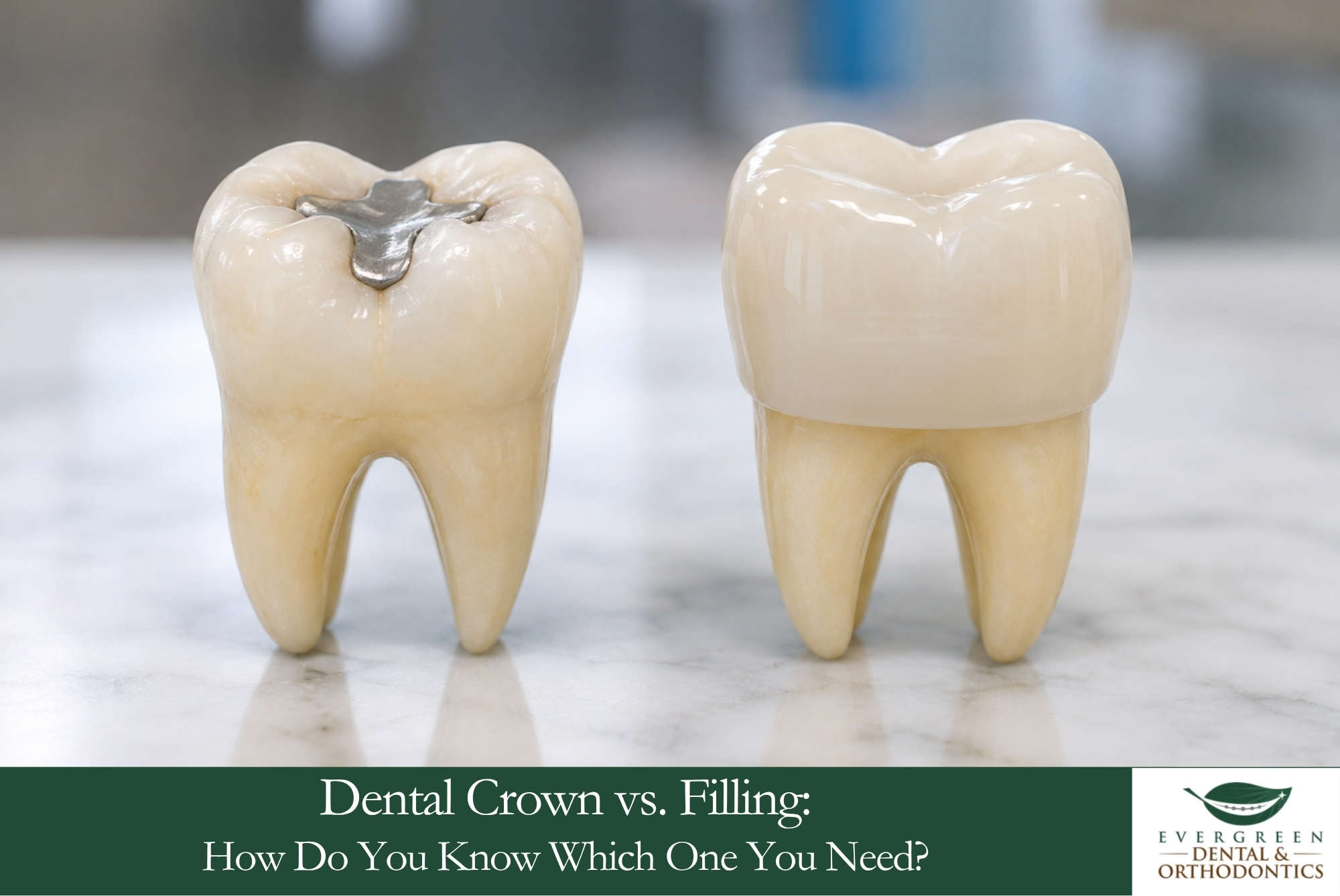
 When a tooth is damaged by decay, a crack, wear, or an old restoration, your dentist may recommend either a dental filling or a dental crown. Both treatments can restore damaged teeth, but they serve different purposes. A filling typically repairs a smaller, localized area of tooth damage, while a crown covers and reinforces a larger portion of a tooth that needs more extensive protection.
Understanding the difference between a dental crown and a filling can help you know what to expect when discussing treatment options with your dentist. However, the right restoration cannot be determined by symptoms alone. A dental examination, and often dental X-rays, is necessary to evaluate how much healthy tooth structure remains and whether deeper areas of the tooth are affected.
At Evergreen Dental & Orthodontics in Encino, CA, patients can receive an individualized evaluation to determine which restorative treatment is appropriate for their dental needs.
What Is a Dental Filling?
A dental filling is a restorative treatment used to repair a relatively small area of tooth structure that has been damaged, most commonly by dental decay.
During filling treatment, the dentist removes the decayed or compromised tooth structure, prepares the remaining area, and places restorative material to rebuild the missing portion of the tooth. Tooth-colored composite resin is commonly used because it can be shaped and shaded to blend with surrounding tooth structure.
When Is a Filling Usually Recommended?
A filling may be appropriate when tooth decay or damage is limited and enough healthy tooth structure remains to support the restoration.
Situations in which a dentist may consider a filling include small to moderate cavities, localized areas of damaged tooth structure, and replacement of certain worn or defective existing fillings.
The amount and location of remaining healthy tooth structure are important. Two cavities that appear similar in size may require different treatment if one weakens a critical part of the tooth.
What Is a Dental Crown?
A dental crown is a restoration designed to cover the visible portion of a tooth above the gumline. It is sometimes described as a “cap” because it surrounds the prepared tooth and restores its shape, function, and structural integrity.
Crowns can be made from several dental materials. The appropriate material depends on factors such as the tooth’s location, biting forces, appearance, and individual clinical requirements.
When Is a Dental Crown Usually Recommended?
A crown is generally considered when a tooth has lost enough structure that a filling alone may not provide adequate long-term reinforcement.
A dentist may recommend a crown for a tooth with extensive decay, a large existing filling, significant fracture or cracking, substantial wear, or other structural damage. Crowns are also frequently used to restore teeth after root canal treatment when additional structural protection is indicated.
The goal is not simply to replace missing material. A crown can help distribute biting forces across a compromised tooth and protect remaining tooth structure.
Dental Crown vs. Filling: What Is the Main Difference?
The primary difference between a crown and a filling is the amount of the tooth being restored and protected.
A filling replaces a localized area of missing or damaged tooth structure. Much of the natural tooth remains uncovered.
A crown, by comparison, covers most or all of the visible portion of the prepared tooth. This provides more extensive coverage when the remaining tooth needs additional reinforcement.
In simple terms, a filling repairs a damaged area, while a crown provides broader protection for a more structurally compromised tooth.
How Does a Dentist Decide Between a Crown and a Filling?
Choosing between a dental crown and filling requires more than simply measuring a cavity. Your dentist evaluates the overall condition of the tooth and considers how the restoration will function over time.
Amount of Healthy Tooth Structure Remaining
One of the most important considerations is how much strong, natural tooth structure remains after decay or damaged material is removed.
When substantial healthy structure remains, a filling may provide sufficient restoration. When a significant portion of the tooth is missing or weakened, a crown may provide greater reinforcement.
Size and Location of the Cavity
Small areas of decay are often suitable for fillings. As a cavity becomes larger, however, the remaining walls and cusps of the tooth can become weaker.
Location matters as well. Areas subjected to substantial chewing pressure may require different restorative considerations than less heavily loaded surfaces.
Cracks and Fractures
A cracked or fractured tooth requires careful evaluation. Depending on the type, location, and extent of the crack, a crown may be recommended to protect the tooth and reduce stress on compromised areas.
Not every crack can be treated with a crown, however. Cracks extending deeply into the tooth or root may have a different prognosis, which is why professional diagnosis is essential.
Existing Fillings
Teeth with very large or multiple previous fillings can have less natural structure remaining. Over time, the remaining tooth may become more vulnerable to fracture.
If an old filling fails, the dentist must determine whether another filling can be predictably supported or whether more comprehensive coverage is appropriate.
Condition of the Dental Pulp
The dental pulp contains nerves, blood vessels, and connective tissue inside the tooth. Deep decay, fractures, or trauma can affect this tissue.
If the pulp becomes irreversibly inflamed or infected, root canal treatment may be necessary before the tooth receives its final restoration. The need for a root canal and the need for a crown are separate clinical decisions, although they can sometimes occur as part of the same treatment plan.
Your Bite and Chewing Forces
Dentists also consider the forces placed on a tooth during chewing. Tooth location, bite relationships, clenching, grinding, and other factors can affect how much stress a restoration must withstand.
Can a Filling Be Too Large?
Yes. There is a point at which placing a larger filling may leave insufficient natural tooth structure to predictably withstand chewing forces.
A large filling occupies space that was previously natural tooth structure. If only thin walls or weakened cusps remain, those areas may be more susceptible to fracture.
This does not mean every large filling automatically requires a crown. The decision depends on the specific tooth, the extent and location of damage, remaining tooth structure, bite forces, and other clinical findings.
Why Might a Dentist Recommend a Crown Instead of a Filling?
When a dentist recommends a crown, the recommendation is generally based on the structural condition of the tooth rather than simply the presence of decay.
For example, removing decay from a severely damaged tooth might leave too little strong tooth structure to reliably support a conventional filling. A crown may then provide more comprehensive coverage and reinforcement.
A crown may also be considered when a tooth contains an extensive existing restoration, has fractured cusps, or is at elevated risk of additional structural failure.
Can You Get a Filling Instead of a Crown?
Sometimes, but only when a filling can adequately restore the tooth.
Patients may prefer a filling because treatment can be less extensive, but the least extensive procedure is not necessarily the most appropriate treatment for every tooth. If the remaining structure cannot adequately support a filling, choosing one solely to avoid a crown may not address the underlying structural problem.
Your dentist can explain why a particular restoration is recommended and what alternatives may be available.
What Happens During a Dental Filling Procedure?
The exact procedure varies according to the tooth and restorative material, but treatment generally begins with examination and diagnosis. Local anesthetic may be used to keep the area comfortable.
The dentist removes decay and compromised tooth material before preparing the area for the filling. The restorative material is then placed, shaped, and adjusted so the tooth can function appropriately within the patient’s bite.
With composite restorations, the material is typically applied and hardened using a dental curing light.
What Happens During a Dental Crown Procedure?
Crown treatment generally requires the tooth to be prepared so the final restoration can fit over it properly. Damaged or decayed areas are addressed, and the tooth is shaped to create room for the crown.
An impression or digital scan may be taken to help fabricate the restoration. Depending on the treatment process used, a temporary crown may protect the prepared tooth while the final restoration is being made.
When the final crown is ready, the dentist evaluates its fit, bite, and appearance before securely attaching it to the prepared tooth.
Specific procedures and appointment requirements can vary according to the individual case.
Dental Crown vs. Filling: Which Lasts Longer?
There is no universal lifespan for either restoration. Both fillings and crowns can function successfully for years, but longevity varies considerably.
Factors affecting the lifespan of a dental restoration include oral hygiene, restoration size and material, tooth location, diet, decay risk, clenching or grinding, bite forces, and regular dental care.
A smaller restoration on a healthy, well-maintained tooth may perform differently from a crown placed on a heavily damaged tooth. For this reason, lifespan estimates should not be used by themselves to determine which treatment is better.
The best restoration is the one that appropriately addresses the tooth’s clinical condition.
What Are Signs You May Need a Filling or Crown?
Tooth problems can produce several symptoms, but symptoms alone cannot tell you whether you need a filling, crown, root canal, or another treatment.
Possible warning signs include tooth sensitivity, pain when biting or chewing, visible cavities, a chipped or fractured tooth, food repeatedly becoming trapped around a tooth, a loose or damaged filling, or sensitivity to hot, cold, or sweet foods and drinks.
Some dental decay produces few or no noticeable symptoms in its earlier stages. Routine dental examinations can therefore help identify problems before they become more extensive.
Does Tooth Pain Mean You Need a Crown?
Not necessarily. Tooth pain has many potential causes.
Pain may result from tooth decay, a cracked tooth, an inflamed or infected pulp, gum problems, bite-related stress, or other dental conditions. A crown is appropriate only when the diagnosis indicates that it will address the underlying problem and provide necessary restoration or protection.
Persistent or significant dental pain should be professionally evaluated rather than self-diagnosed.
What If Decay Is Too Deep for a Filling?
Deep decay requires evaluation of both the remaining tooth structure and the health of the dental pulp.
In some cases, a tooth with deep decay may still be restored without root canal treatment. In others, decay may have caused irreversible inflammation or infection of the pulp, making additional treatment necessary.
After diseased tissue is addressed, the dentist determines what type of final restoration can appropriately rebuild and protect the tooth.
Is a Crown Always Necessary After a Root Canal?
Not every root canal-treated tooth automatically receives the same restoration. The decision depends on factors including tooth type, remaining structure, location, previous restorations, and expected biting forces.
Back teeth frequently require substantial protection because they experience significant chewing forces. Your dentist can evaluate whether a crown or another type of restoration is appropriate after root canal treatment.
Can a Crown Prevent a Tooth From Cracking?
A crown can reinforce and protect a weakened tooth by covering compromised tooth structure and distributing biting forces. However, no dental restoration can guarantee that a tooth will never crack or develop another problem.
Good oral hygiene, routine dental visits, appropriate use of protective appliances when recommended, and avoiding habits such as chewing ice or other extremely hard objects may help protect both natural teeth and restorations.
What Happens If You Delay Treatment?
Dental decay does not heal on its own. If decay progresses, a tooth that might initially have been treatable with a smaller restoration may eventually require more extensive treatment.
Similarly, continuing to chew on a significantly weakened or cracked tooth can potentially lead to additional damage.
Early diagnosis may provide more opportunities to preserve healthy tooth structure, although the appropriate treatment depends on the individual diagnosis.
Severe pain, facial swelling, fever associated with a dental problem, or difficulty swallowing or breathing warrants prompt professional attention.
Are Crowns and Fillings Permanent?
Crowns and fillings are considered long-term dental restorations, but they should not be assumed to last indefinitely.
Restorations can eventually wear, chip, fracture, loosen, or develop problems around their margins. New decay can also develop in remaining natural tooth structure.
Daily brushing, interdental cleaning, appropriate dietary habits, and regular dental examinations help support the health of restored teeth.
How Can You Protect a Filling or Crown?
Restored teeth still require consistent oral care.
Brush your teeth thoroughly with fluoride toothpaste, clean between your teeth regularly, and maintain professional dental examinations and cleanings at intervals recommended for your individual oral health needs.
If you clench or grind your teeth, discuss it with your dentist. In appropriate cases, a protective appliance may be recommended to reduce excessive forces on teeth and restorations.
Avoid using your teeth to open packages or bite objects that are not food. These habits can place unnecessary stress on both natural teeth and dental restorations.
Dental Crown vs. Filling: Which Treatment Is Right for You?
There is no single answer that applies to every damaged tooth.
A filling is generally suited to localized damage when sufficient healthy tooth structure remains. A crown provides more extensive coverage and may be appropriate when a tooth is significantly weakened, extensively restored, fractured, or otherwise requires greater structural protection.
The decision should be based on a clinical examination rather than appearance or symptoms alone. Dental X-rays and other diagnostic tests may also be needed to determine the extent of decay, assess the tooth’s internal health, and evaluate surrounding structures.
If you have a damaged tooth, cavity, failing restoration, or unexplained dental discomfort, Evergreen Dental & Orthodontics in Encino can evaluate the tooth and discuss appropriate restorative options based on your individual needs.
Frequently Asked Questions About Dental Crowns and Fillings
How do I know if I need a crown or filling?
You generally cannot determine this reliably at home. A dentist needs to evaluate the extent of damage, remaining healthy tooth structure, existing restorations, cracks, bite forces, and other clinical factors. Dental X-rays may also be necessary.
Is a crown better than a filling?
Neither treatment is inherently better. A filling may be preferable when a smaller amount of tooth structure needs restoration, while a crown may be more appropriate when the tooth requires extensive coverage and reinforcement.
Can a large cavity be filled?
Some relatively large cavities can be restored with fillings, but the decision depends on how much healthy tooth structure remains and whether that structure can adequately support the restoration. If the tooth is substantially weakened, another restorative option may be recommended.
Why would a tooth need a crown if it does not hurt?
Pain is not an accurate measurement of structural damage. A tooth can have extensive decay, a large failing restoration, or significant weakening without causing noticeable pain. Treatment recommendations are therefore based on clinical findings as well as symptoms.
Can a cracked tooth be treated with a filling?
It depends on the crack’s location, depth, and extent. Minor defects may require conservative treatment, while a structurally compromised tooth may need a crown. Some severe cracks may not be restorable. A dental examination is necessary to determine the appropriate treatment.
Do crowns require removing more tooth structure than fillings?
Crown preparation generally involves reshaping more of the tooth because the restoration needs room to cover the prepared tooth. A filling usually focuses on a localized damaged area. Dentists consider preservation of healthy tooth structure alongside the need to create a durable restoration.
Does getting a crown hurt?
Local anesthetic is commonly used during tooth preparation to minimize discomfort. Some temporary sensitivity or soreness can occur afterward. Persistent or worsening pain should be reported to your dentist.
Does getting a filling hurt?
Local anesthetic may be used during filling treatment, depending on the location and depth of the restoration. Patients may experience temporary sensitivity afterward, particularly with deeper fillings.
Can decay develop underneath a crown?
Decay can develop in the natural tooth structure around the margins of a crown. Maintaining good oral hygiene and regular dental examinations remains important even after a tooth has been crowned.
Can you get a cavity around an existing filling?
Yes. New decay can develop in natural tooth structure adjacent to an existing filling. Fillings can also wear or develop marginal problems over time, which is one reason restored teeth should continue to be professionally monitored.
Can an old filling be replaced with another filling?
Sometimes. If enough healthy tooth structure remains, replacing an old filling with a new restoration may be possible. If the tooth has become extensively weakened or damaged, a crown or another treatment may be considered.
How long do dental crowns and fillings last?
There is no guaranteed lifespan. Longevity depends on the restorative material, size and location of the restoration, oral hygiene, decay risk, chewing forces, grinding habits, diet, and other individual factors.
Do you always need a root canal before getting a crown?
No. Many crowns are placed on teeth that have not undergone root canal treatment. Root canal therapy is used when the dental pulp is affected in a way that requires endodontic treatment; a crown addresses restoration and structural protection. They serve different purposes.
Should I replace a filling before it breaks?
Not every older filling needs replacement simply because of its age. Dentists evaluate restorations for signs such as recurrent decay, fractures, leakage, significant wear, or loss of structural integrity. Replacement should be based on clinical findings.
What should I do if my filling or crown falls out?
Contact a dentist promptly for evaluation. Avoid chewing hard or sticky foods on the affected tooth, and do not attempt to permanently reattach a restoration yourself. The dentist will determine whether the existing restoration can be recemented or whether repair, replacement, or another treatment is needed.
When should I see a dentist about a damaged tooth?
Schedule an evaluation if you notice pain, sensitivity, a visible cavity, a broken or chipped tooth, discomfort while chewing, or a damaged or missing restoration. Prompt evaluation is particularly important when symptoms are worsening or interfering with normal eating and daily activities.
Schedule a Dental Evaluation in Encino, CA
If you are wondering whether a damaged tooth needs a dental crown or filling, an examination can provide a clear answer based on the condition of your tooth.
Evergreen Dental & Orthodontics provides dental care in Encino, California. A dentist can evaluate decay, fractures, existing restorations, remaining tooth structure, and other relevant factors before discussing suitable treatment options.
Rather than waiting for a weakened tooth to become more extensively damaged, schedule an evaluation to learn which restorative approach is appropriate for your individual dental needs.
Contact Information
Evergreen Dental & Orthodontics
17130 Ventura Blvd Suite 150
Encino, CA 91316
Phone: (818) 357-2255
Website: evergreendentals.com
Request An Appointment: evergreendentals.com/appointments/